OTOS Continuity helps the NHS and partner organisations connect care, support and recovery services into one joined-up pathway — starting with the most underserved cohort in the system.
Thousands of people are cycling through addiction services, mental health crisis, homelessness and revolving-door hospitalisation — while the underlying cause remains undiagnosed and untreated.
Royal College of Psychiatrists research shows ADHD is massively underdiagnosed in addiction cohorts — yet it is often the root driver.
Much of this spend is reactive. Treating the symptom without identifying the underlying neurodevelopmental cause keeps people trapped in cycles.
OTOS has already identified 877 people within Cambridge who match the target cohort profile — adults cycling through services with likely undiagnosed ADHD.
Treating ADHD in patients with co-occurring substance use disorder produces benefit — not only for ADHD symptoms, but for substance use outcomes too. There is more benefit than risk from treating ADHD in this cohort.— Royal College of Psychiatrists, ADHD with Substance Use: A Clinical Dilemma (2022)
OTOS Continuity creates a connecting layer that links care, support and recovery services around one person's real journey — so nothing falls through the gaps.
Screen and identify individuals in addiction, recovery and crisis services who show signs of undiagnosed ADHD using a validated pathway.
Warm-transfer individuals to appropriate NHS and partner services — ADHD assessment, Right to Choose, CPFT, GP, mental health support.
Maintain a continuity thread across services so each partner knows where the person is in their journey — reducing gaps, duplication and crisis.
Support appropriate medication, ongoing recovery and re-engagement — building evidence for a permanent joined-up service model.
Treating the underlying neurodevelopmental condition reduces substance use, crisis behaviour, and revolving-door presentations — backed by NICE guidance and RCPsych evidence.
OTOS does not replace existing services — it connects them. The model works with NHS, VCSE, and private partners already delivering in the community.
Every individual in the pilot is tracked through their thread. Outcomes are measured, evidenced, and ready for ICB commissioning review.
The model is designed to redirect money already being spent on reactive crisis care into proactive, joined-up early intervention — reducing total cost.
The pre-pilot demonstrator targets 50 high-priority individuals from an already-identified cohort of 877 — with partners warmed up and ready to move.
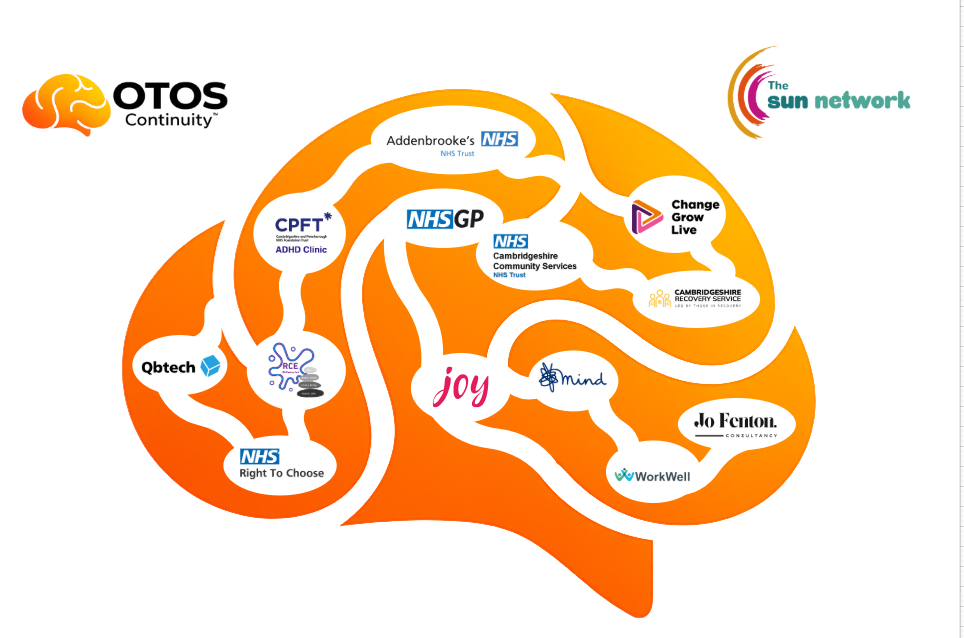
OTOS Continuity sits at the centre of an existing partner ecosystem — organisations already delivering services in Cambridge, already working with this cohort.
The OTOS Continuity Layer connects these partners around one person's journey — ensuring that as they move between services, they are never lost, never starting over, and never falling through the gap between organisations.
OTOS Continuity was built by someone who went through the system — addiction services, mental health crisis, revolving-door care — before finally being diagnosed with combined ADHD and privately medicated with Elvanse.
The transformation was immediate. The addiction fell away. The research confirmed what lived experience had always suggested: it was the ADHD driving it.
But thousands of people in Cambridge — and hundreds of thousands nationally — are still in the same cycle. Still undiagnosed. Still untreated for the root cause.
OTOS Continuity exists to change that. Not as a charity project — as a properly commissioned, evidence-led, partner-connected NHS pathway that saves money while transforming lives.
The research says what I always knew through my own journey. It's the ADHD driving it. Treat the cause, not just the symptom.
"There is more benefit than risk from treating ADHD in patients with substance use disorder — both in terms of ADHD and substance use symptom reduction."
NICE guidance covers ADHD with coexisting substance misuse — and supports assessment and treatment of ADHD even in active substance use contexts.
"Lisdexamfetamine appeared to reduce craving for cocaine in cocaine misuse. No evidence was found of misuse of lisdexamfetamine in patients being properly treated."
Change Grow Live trialled an ADHD identification and referral pathway in Nottingham. Frontline workers, with light-touch training, successfully screened caseloads — with warm referral producing significantly better engagement.
We are currently in active conversation with NHS commissioners, ICB leads, and Public Health teams. If you want to understand more or explore partnership, we want to hear from you.